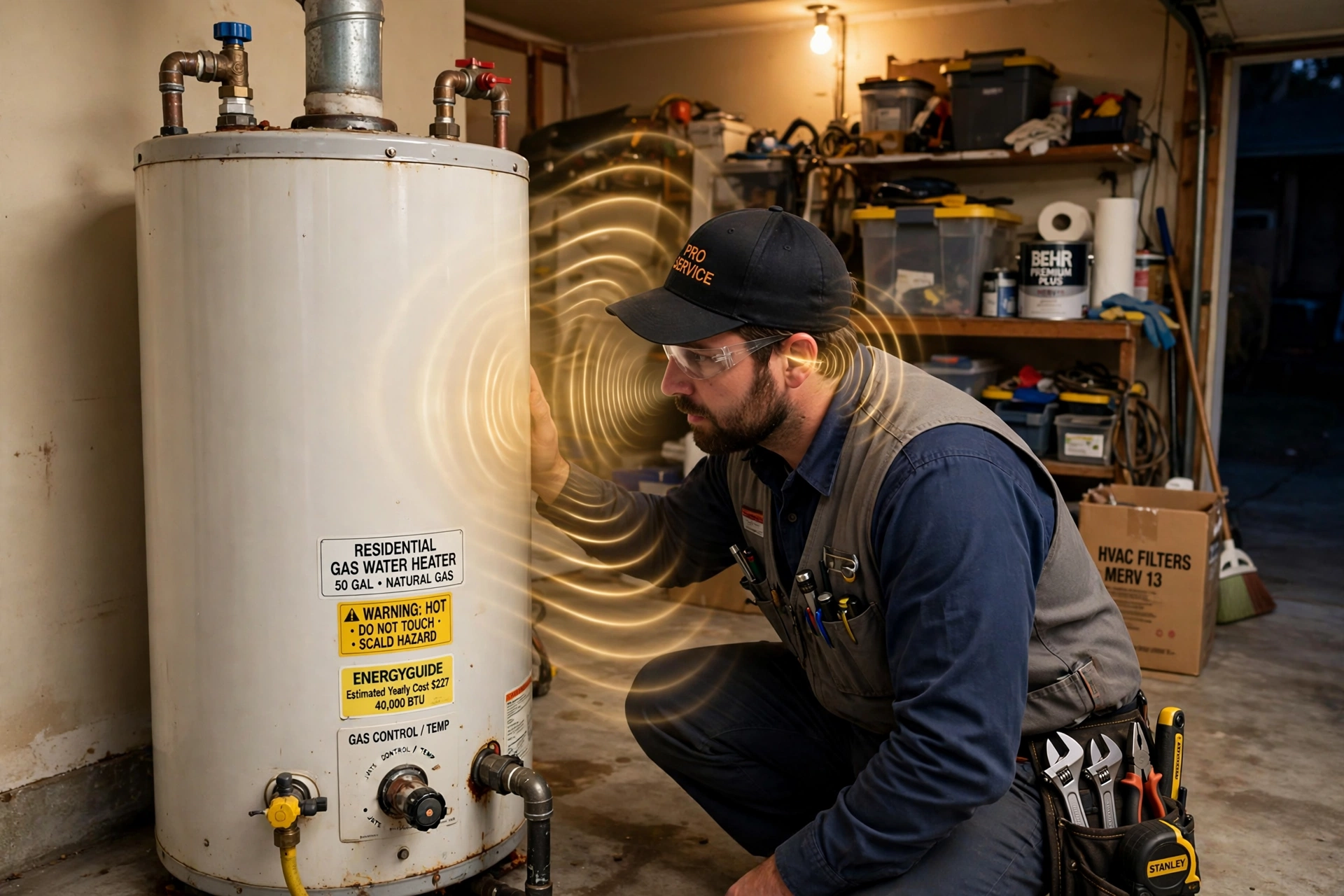
Water Heater Making Noise? Popping, Rumbling and Banging Sounds
A noisy water heater is almost always telling you the same thing: there's sediment at the bottom of the tank. That popping, rumbling, or banging sound is water trapped under a layer of mineral buildup, boiling into steam and bursting through. It's the single most common water heater complaint we see in Lawrenceville, GA — and while the noise itself is rarely an emergency, it means your unit is working harder than it should and quietly shortening its own life. Below is a sound-by-sound guide: find your noise, learn what it means, and find out exactly what to do about it.
Which Sound Is Yours? The Quick Diagnostic
Match what you're hearing to the likely cause — and, more importantly, to whether it needs action now.
| Sound | Likely cause | What to do | Urgency |
|---|---|---|---|
| Popping, crackling, rumbling | Sediment buildup | Flush the tank | Soon — not an emergency, but don't ignore it |
| Loud banging / knocking | Severe sediment, water hammer, or loose parts | See below to tell which | Soon |
| Hissing | Leaking water hitting hot metal, or the T&P relief valve | Inspect immediately | Act now |
| Sizzling (electric units) | Scale on the heating elements | Flush / descale | Soon |
| Screeching or whining | Restricted valve or high pressure | Check pressure, inspect valves | Act now |
| Humming or vibration | Loose burner or heating element | Tighten or replace the part | Soon |
| Ticking, clicking, dripping taps | Normal pipe expansion | Usually nothing | Ignore |
| Gurgling | Air in the tank or pipes | Usually nothing | Ignore |
Popping and Rumbling: Sediment at the Bottom of the Tank
Here's what's happening inside your tank when it pops and rumbles. Over months and years, minerals from your water supply — calcium, magnesium, rust particles — settle at the bottom of the tank and form a sediment layer. When the burner fires (or the lower element heats), water trapped beneath that layer gets extremely hot. Sometimes hot enough to turn to steam. That steam forces its way up through the sediment in small bursts — and you're hearing those bursts as popping and rumbling.
Georgia's water makes this worse than average. Lawrenceville and much of Gwinnett County have moderately hard water, so sediment builds up faster here than in soft-water regions. Many homeowners notice the noise within a year or two of a fresh install, especially if the tank has never been flushed.
The noise is annoying but not immediately dangerous. The real problem is what the sediment is doing while you listen to it:
- It insulates the burner from the water. The burner has to run longer and hotter to heat the same water, which raises your energy bills and stresses the tank.
- It overheats the tank bottom. That hot spot weakens the steel and accelerates corrosion — the same sediment that pops today can crack the glass lining tomorrow.
- On electric units, it buries the lower element. Scale on elements causes sizzling and crackling, and buried elements burn out early.
In short: popping is your early warning. The fix is to flush the tank — and then flush it on a schedule so the noise doesn't come back.
Banging and Knocking: Sediment, Water Hammer, or Loose Parts
Loud banging has three common causes, and you can usually tell them apart by when the banging happens:
- During or right after the heater runs — severe sediment. Same mechanism as the popping above, just further along. If the noise has gotten worse over weeks or months, this is the likely answer.
- Right when a faucet, dishwasher, or washing machine shuts off — water hammer. This is a pressure shock in your pipes from valves closing suddenly, not a water heater problem at all. The fix is a water hammer arrestor on the offending line, not a heater repair.
- Rattling or knocking that vibrates the unit itself — a loose heating element or dip tube. On gas units, check the burner assembly for loose parts. These vibrate when water moves through the tank.
There's a fourth, subtler cause: thermal expansion. As water heats it expands, and in a closed plumbing system that pressure has nowhere to go — which can produce loud bangs. A thermal expansion tank on the water line absorbs the pressure and usually ends the noise. If your home doesn't have one, that's a worthwhile add regardless of the noise.
Hissing, Sizzling, and Screeching
- Hissing needs your attention right away. It can mean water dripping onto hot metal (a leak you should find), or the temperature-and-pressure (T&P) relief valve doing its job — releasing excess pressure. A T&P valve that hisses constantly may be faulty, and a faulty T&P valve is a safety device that isn't protecting you. Never cap or plug it; get it inspected. If hissing comes with very hot water or steam, lower the thermostat to 120°F and call a professional the same day. Kettling — water boiling at the bottom of an overheating tank — also hisses, and it means the thermostat may be set too high.
- Sizzling or crackling in an electric unit is scale on the heating elements. Same sediment story, different location. Flushing helps; if the elements are heavily scaled, replacing them is a standard, affordable repair (see typical numbers in our repair cost guide).
- Screeching or high-pitched whining usually points to a restricted valve or excessive incoming water pressure. Check that valves near the heater are fully open, and have your water pressure tested — anything above 80 psi stresses the tank and every joint in the system.
Humming and Vibration
A steady hum is usually mechanical, not sediment. On gas units, it's often the burner assembly or loose mounting hardware vibrating. On electric units, a loose heating element can vibrate in its socket. Turn off power to the unit before poking around — if tightening what's loose doesn't fix it, the burner or element may be failing. This is one of the easier fixes for a professional visit, and rarely a sign you need a new unit.
Ticking, Clicking, and Gurgling: Usually Normal
Not every sound is a symptom. As the tank heats and cools, the metal expands and contracts — that produces soft ticking and clicking, often heard in the walls where pipes run. Gurgling is usually air moving through the tank or pipes. If these sounds are new, louder than usual, or come with another symptom (no hot water, leaks, error codes on a tankless unit), investigate. Otherwise, they're normal operating sounds, and chasing them usually wastes money.
When a Noisy Water Heater Is Dangerous
Most noises can wait for a scheduled visit. Stop using hot water and call a professional immediately — or leave the house and call your gas utility/911 — if you notice:
- Hissing with steam or scalding-hot water — possible T&P valve failure or severe overheating. Turn off the heater, don't touch the relief valve, and call a pro the same day.
- A rotten-egg smell or gas odor — leave the house first, call your gas utility or 911, and don't relight anything yourself.
- Water pooling around the base — even a small puddle. A leaking tank cannot be repaired (though a leaking valve or fitting often can — our leak guide shows how to tell the difference).
- Repeated breaker trips or a burning smell on an electric unit — shut off the breaker and call for service.
- Boiling or kettling sounds with the thermostat already at 120°F — the thermostat or high-limit control may have failed.
If the noise is popping or rumbling with none of the above — water is hot, no leaks, no smells — you have time. Schedule a flush; don't ignore it, but don't panic either. Our troubleshooting guide covers the rest of the symptom list.
How to Quiet a Noisy Water Heater
1. Flush the tank
This is the fix for the vast majority of noisy units. The short version: turn off the heater, attach a garden hose to the drain valve, and drain until the water runs clear. It takes about an hour, and a professional flush typically runs $100–$200 (a DIY flush costs roughly $30 in supplies). In hard-water areas like Gwinnett County, do it every 6 months rather than once a year. Our maintenance guide has the full checklist, and our sediment flush service covers the professional option in Lawrenceville.
2. If flushing doesn't fix it, the sediment may be hardened
A simple drain doesn't always clear years of buildup. Sediment can bake into a solid crust — particularly in units that have never been flushed — that a standard drain won't dislodge. In that case a professional descaling (circulating a descaling solution through the tank) is the next step. If even descaling doesn't quiet the unit, the noise may be telling you the tank is nearing the end — compare repair costs against replacement in our repair-or-replace guide and see what's fixable and what isn't.
3. Address the sound-specific causes
- Water hammer → install water hammer arrestors.
- Thermal expansion banging → install an expansion tank.
- Loose element or burner → tighten or replace the part (safe DIY boundaries here).
- Screeching / high pressure → test incoming pressure; install a pressure-reducing valve if it's above 80 psi.
4. Keep it quiet long-term
- Flush on schedule. Every 6 months in Lawrenceville's water; once a year at minimum.
- Keep the thermostat at 120°F. Hotter water accelerates scale and corrosion (and raises scald risk).
- Consider a water softener if your water is very hard — less mineral in, less sediment out.
- Have the anode rod checked every 2–3 years in Georgia. A depleted rod lets the tank rust from the inside, and a rusting tank is a noisy tank heading for failure. Details in our anode rod guide.
A rumbling water heater is a maintenance reminder, not a death sentence. Flush it now, keep it on schedule, and the quiet usually comes back — along with lower bills and a longer-lived tank. If the noise persists after a flush, or you hear anything from the danger list above, call Water Heater Pros — we'll diagnose it and tell you honestly whether you need a flush, a part, or a replacement.